0 Comments
Now that you know you can siphon and transfer gas easily from your power equipment as well as new and older cars (please see the rest of the GasTapper website) what should your policy be for eliminating your old gas / fuel? Many customers that use GasTapper have a strategy for cycling gas in and out of their power equipment so that the gas does not go stale and damage the equipment. When you pull the gasoline out of your tractor, lawnmower, generator, snow blower, idle car, etc., what do you do with it?
The best policy I found, short of using it for weed killer (all kinds of issues here) is to add it to good gas and burn it. Depending on how old the gas is (your nose will tell you as the older it is, the more it smells like turpentine) you should limit the dilution of your old gas to new gas to a maximum of 5%. This rule primarily applies to cars, you can go a bit higher when dealing with general power equipment. They are less sensitive to the old fuel (usually no fuel njectors or computers). I’ve regularly added 10% to power equipment items with no issues at all. Just use the fuel you’ve mixed quickly. Don’t let it sit around where it might continue the aging process. What about gas from two strokes or gas mixed with oil? I have good luck mixing that fuel into a non-two stroke motor at 5%. I would not recommend doing this with any newer car. Gas goes bad? Yes, now with the new blends, it happens faster than ever. Gas that is left standing will go bad in as little as 3 months. The rule used to be up to 5 months, but that is changing with the new blends. This is one of the primary uses of the GasTapper product line. Old fuel leaves residue in fuel systems and burns with less energy than new fuel. We recommend cleansing your power equipment every 3 months with new fuel. The best way to do this is to either run the fuel out (not always possible) or pull it out and burn it in something that you are currently using. Replace that fuel with new fuel. Should you use a product that extends the life of gas? Absolutely. There are several products on the market out there. We’ve had great luck with the Sta-bil product. This gives you a more comfortable window of 6 months or more depending on the temperature during storage. The warmer it is, the faster gas goes bad. So I'm on my way to Vegas to work a trade show and I'm driving from Arizona to Las Vegas. There’s this wonderful stretch of highway after Kingman where the scenery is spectacular and you let your mind wonder and enjoy a good audio book. My mind wondered so far, I never bothered to look at the gas gauge. Now I have to tell you that even though I preach “one in every trunk” meaning GasTapper, I don’t always follow that rule. We made the manual siphon model so that it would be affordable enough to do just that.
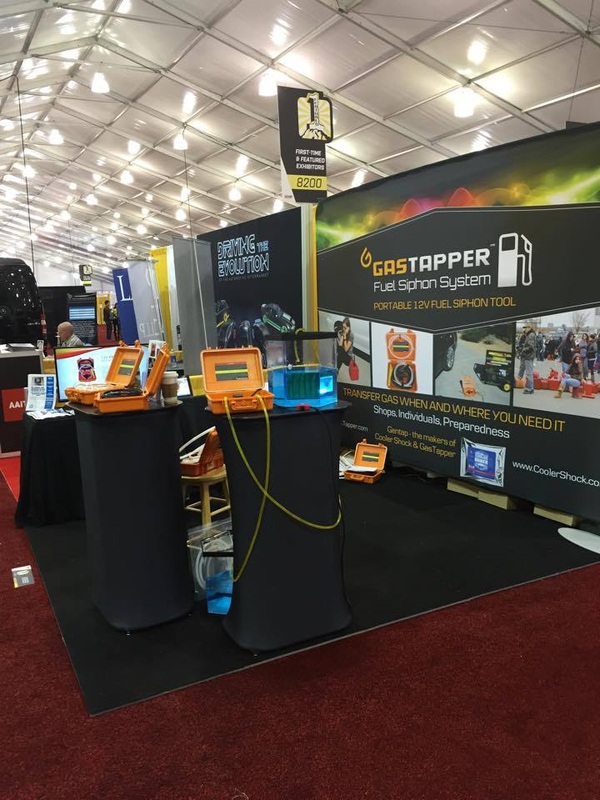
Now on with the story. I found myself somewhere between “Nothing Arizona” and “Wikiup Arizona” when I realized I might not have enough fuel to make it to the next gas station. I checked with my smart phone and it indicated that the next station was greater than my remaining range. I pulled over in a scenic view area and got to talking with another fella about where the next station is. I also got to talking about GasTapper. Since I was traveling to a show, I had several in the trunk. The man was interested and the deal was struck. I gave him a GasTapper Gravity and he allowed me to pull a couple of gallons out of his car. Now I’m not selling aggressively here, I’m just pointing out that the old adage about the shoemaker with shoes that need repair applies to me as well. GasTapper is not just for Preppers and disasters, it really is like a pair of jumper cables. When I got home, I put one in all of my three Daughter’s trunks as well as my Spouse’s car. During late November and early December 2014 I've had the privilege of working with several customers in the field to help them with the GasTapper. I enjoy each experience and wish I could visit with every customer to show them the tricks and techniques to be successful getting gas out of their vehicles. We've started to post cell phone videos of our field experience as this is one of the best ways for customers to "get the knack". To be clear, GasTapper will not work on every vehicle and we continue to test and expand the success list. At this point, we are achieving a 90% success rate with the most difficult cars being the newest (2012 and up). Today I want to share with you two field experiences that really helped us with how we can better communicate to our customers how to use GasTapper. One was with a gentleman who works for the local Sheriff’s department and wanted to get gas out of his 2011 Nissan Armada in order fill his boat when down in Mexico. There is no local gas supply near where the boats are kept. The other story is about a gentleman who has a 2015 KIA Sorrento. He intended to fill his plane which runs on auto fuel with his car while at the local airport, rather than pay the high price for aviation gas (AVGAS). In both cases they purchased the GasTapper 12v but were struggling to get it fully into the tank. For each case the key to success was to pull back the ½” line once it hit strong resistance so that (1) the ¼” line could be maneuvered past the point of resistance and (2) to get the ¼” line to rotate at the point of resistance so that you could avoid the one point of blockage that you are hitting. This allows you to get to another point just a half inch away that gets you around the blockage. Surprisingly, that blockage is often just the edge of a lip on a hose or elbow on the way into the fuel. So for those of you using GasTapper in a difficult car with twists and turns, you may have difficulty rotating the ¼” line. Try lubricating it with a spray lubricant or moving the ½” line in and out like a piston for 2 inch motions while continuing to push/pull and twist/rotate the ¼” line. Once I showed them the “trick” they were able to reproduce the result quickly and easily. They learned how to tap into their particular vehicle. The Armada video is already posted on the main page in a compilation of videos. I will post the video of the KIA shortly. It’s always great getting out and working in the field and seeing the customer’s joy when they discover that they can get gas out of their vehicle! Here’s picture in the meantime. Thanks to all our customers! Chris A Owner 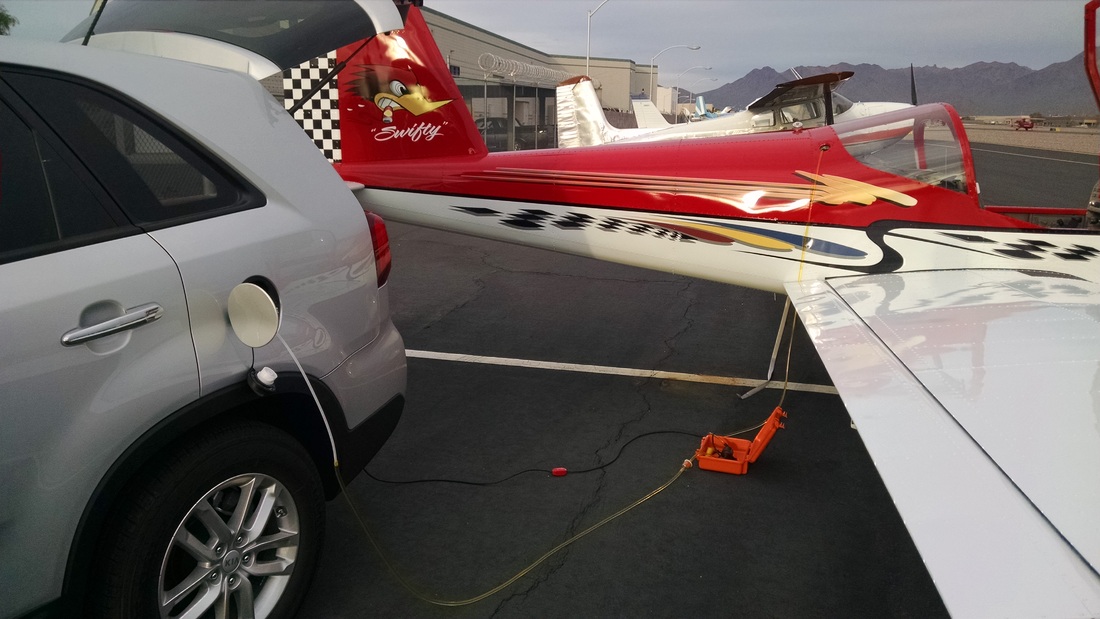 GasTapper had a booth at SEMA 2014, the largest car accessories show in the world. GasTapper won two Global Media awards!
Welcome to the GasTapper Website. After you read our blog please go to the top of this page and visit the GasTapper Store for safe affordable fuel siphon products, both 12V and manual versions. Most models are also sold on Amazon. www.gastapper.com
Have you ever needed some gas for your lawnmower, motorcycle, generator or perhaps tried to help a stranded friend who needed some gas, assuming you could easily get it out of your own vehicle? If you have, you know it’s not possible to siphon gas with conventional tools or standard siphons available on the market today. Many people have tried to siphon gas out of one of their newer vehicles only to find out they hit one if not two major difficulties. It is not easy. Most newer model cars and SUV’s have emergency valves that stop gas from draining out in the event of a roll-over. This valve also acts as a siphon prevention system which is the reason why nearly all the siphon devices and pumps sold these days are useless. That being said, there is a way to siphon gas from a modern car, you just need to know how to do it and have the right tools for the job. The anatomy of the blockage in newer vehicles is a ball valve or butterfly valve. There is enough room for gas to get through the fueling tube into the tank, but if the car flips over and gas begins to flow the other direction, the ball moves to the inlet and blocks the gas from escaping or the butterfly flap closes. The fundamental issue is that you need a line skinny, stiff and flexible enough to get through the valve and around the ball or flap. That is much easier said than done. The first thing you need to get around a ball valve is 6-8 feet of 1/4 inch stiff plastic line with a smooth tapered tip narrowed towards the end with a semi rigid outer guide line to keep the 1/4 inch line from kinking when it hits the initial ball valve. With a firm twisting, bump and pushing motion, it is reasonably easy to get around most ball valves. The next thing you’ll need is a thicker diameter fuel line that can receive the 1/4 inch line without leaking. This line will be used to connect to a fuel filter and then to a pump. Gravity siphoning through the narrow line is doable but extremely slow. With a hand squeeze bulb pump you can move more gas but for best results use a very powerful fuel pump with 7-10PSI and serious self-priming dry-lift capability like the electronic fuel pump that comes with Gas Tapper. To gravity siphon without getting a mouthful of gas you will not only need a hand squeeze bulb to prime the siphon, but you’ll need (2) inline T-connectors with an on/off valve in the middle. This allows you to prime the lines, get gas flowing, then open the valve to allow gravity to take over. Again, this is not a reliable method to go car-to-car. For the lateral transfers, going distance transferring gas up-hill, you’ll really need a pump. The Gas Tapper comes complete with everything you need to access your gas when you need it. Pure siphoning through 1/4 inch line with sufficient gravity, you can move approximately 1 gallon every 8 minutes. Without the 1/4 inch line it's about a half gallon a minute. Moving gas through a 1/4 inch line using a hand squeeze bulb, it is possible to move approximately 1 gallon every 4 minutes (until your hand gives out). Moving gas through a 1/4 inch line using Gas Tapper 12V moves approximately 0.7 gallons per minute or 1 gallon in 1.2 minutes.
Being that electronics can fail and it's always a good idea to have a manual override method as well as those folks looking for lower cost peace-of-mind, Gas Tapper is releasing a hand-powered squeeze bulb model with a gravity override valve which does a nice job, just slower. Check gastapper.com for updates.
Happy Gas Tapping... How to drain a car gas tank
Do you own or run an auto or car repair shop? How about a body shop? Often you need to drain a fuel tank to either service the vehicle or drain the fuel when a vehicle is sold as a total loss. Until now the options were limited. Gastapper can get the gas out and pay for itself with just a few uses. Gastapper has been tested by auto body shops from the east coast to west coast with very satisfied customers. Do you have this need? Let us know and we can share with you the experience of Stainless Steel collision in NY to Rancho Auto Body in San Diego. Are you a Prepper or Survivalist?
What are you doing to be prepared for an emergency or disaster? Stockpiling food and water, that makes sense. Looking to protect yourself? Yup. Notice the price of guns and ammo lately? How about communications? Will your cell phone work when you want it to? This is a real question mark. Depending on the nature of the crisis, it’s not unusual for the cell phone system to be overwhelmed or to lose power. Everyone is on the phone at the same time. Okay, what about energy and transportation? Most folks who believe that we are living in a delicate world will consider alternative power options for emergencies with a generator being the primary solution. If your option is a generator, you have some serious challenges keeping this option ready to go. If you ever actually used the generator, you will have fueled it up which means that you will likely have old gas in it at the time that you need it most. For those of you that haven’t had the experience, gas gets old fast and turns to a varnish like substance, clogging the small ports and orifices in the fuel system (Now you have something else to keep in the back of your mind and aggravate you when you’re trying to sleep). The other challenge is keeping a volume of fuel available for when you need it. Keeping gasoline has many challenges including fumes and fire risk in your home as well as the age issue. It really surprises people to see a metro area like New York discover that the gas stations can’t provide gas when the power is out. This was one of the primary issues during hurricane Sandy. Many folks think you can get gas simply by getting a hose and siphoning it out of a car. Not so much. You will discover that most modern cars will not let you get the hose down into the gas tank. It’s typically an anti-rollover valve that prevents fuel spills. Gastapper was designed to get gas out of modern cars. It also can lift fuel up a substantial distance so that you don’t have to think about using gravity as your only tool to get the gas out. Gastapper has a hose and pump that is designed to get gas out by routing around the rollover valve with a narrow diameter semi rigid hose in combination with the shear strength of an unusually powerful fuel pump that can draw a substantial amount of fuel through this narrow of a hose. So you have food, guns, ammo, how about gas for your cars and generators? Gastapper is a very affordable insurance policy that help complete your preparation strategy and also has many daily uses to keep your gear supplied with fresh gas from your own vehicle. Without it, you have an incomplete plan at a fundamental level. I remember the 2 day power outage of 2011 in San Diego. The first thing that hit me was that I couldn't run out and buy anything. I discovered this when I went to the hardware store to buy a generator and they explained that with no electricity they were unable to do any financial transactions. They bolted up the doors and sent everyone home. I was stunned. I went by the supermarket to buy ice and they also locked the place up. It got me thinking about how fragile our world is. By day 2 folks were getting nervous. No gas, the food was going bad and trucks were not delivering food, since stores were closed and the trucks were unable to get fuel.
Okay, so imagine Hurricane Katrina, Hurricane Sandy and so on. I watched the gas lines in my old home town on Long Island and the news showing the confused faces as everyone began to realize that gas stations could not provide gasoline. It went on for weeks. This was the motivation behind GasTapper. I also considered the many lawn mowers, leaf blowers and weedwackers that I've repaired or thrown out due to gas getting old and fowling the carb or engine. How about those gas cans with the stinky gas in them? With today's additives, stored gas can go bad in about 3 months. What's the plan? Cycle your fuel is often the first thought. You soon discover what a pain that is. I also tried storing gasoline in the garage since the consistent temperature helps preserve the gas a little longer. Unfortunately storing gas in the garage isn't worth the risk of ignition let alone the smell the of gas in the garage. Gas Tapper was designed to make the gas in your vehicle available to you when you need it. |


 RSS Feed
|
Contact Us
GasTapper 325 W Melinda Ln. Phoenix, AZ 85027 602-490-3283 support@gentap.com |

GasTapper, a GenTap, LLC company
Copyright © 2021
Copyright © 2021